How to Prepare for Any Meeting in 60 Seconds Using Your Notes
The best meeting prep isn't a detailed agenda. It's a 60-second review of what you already know about this person, the context that turns a generic conversation into a genuinely memorable one.
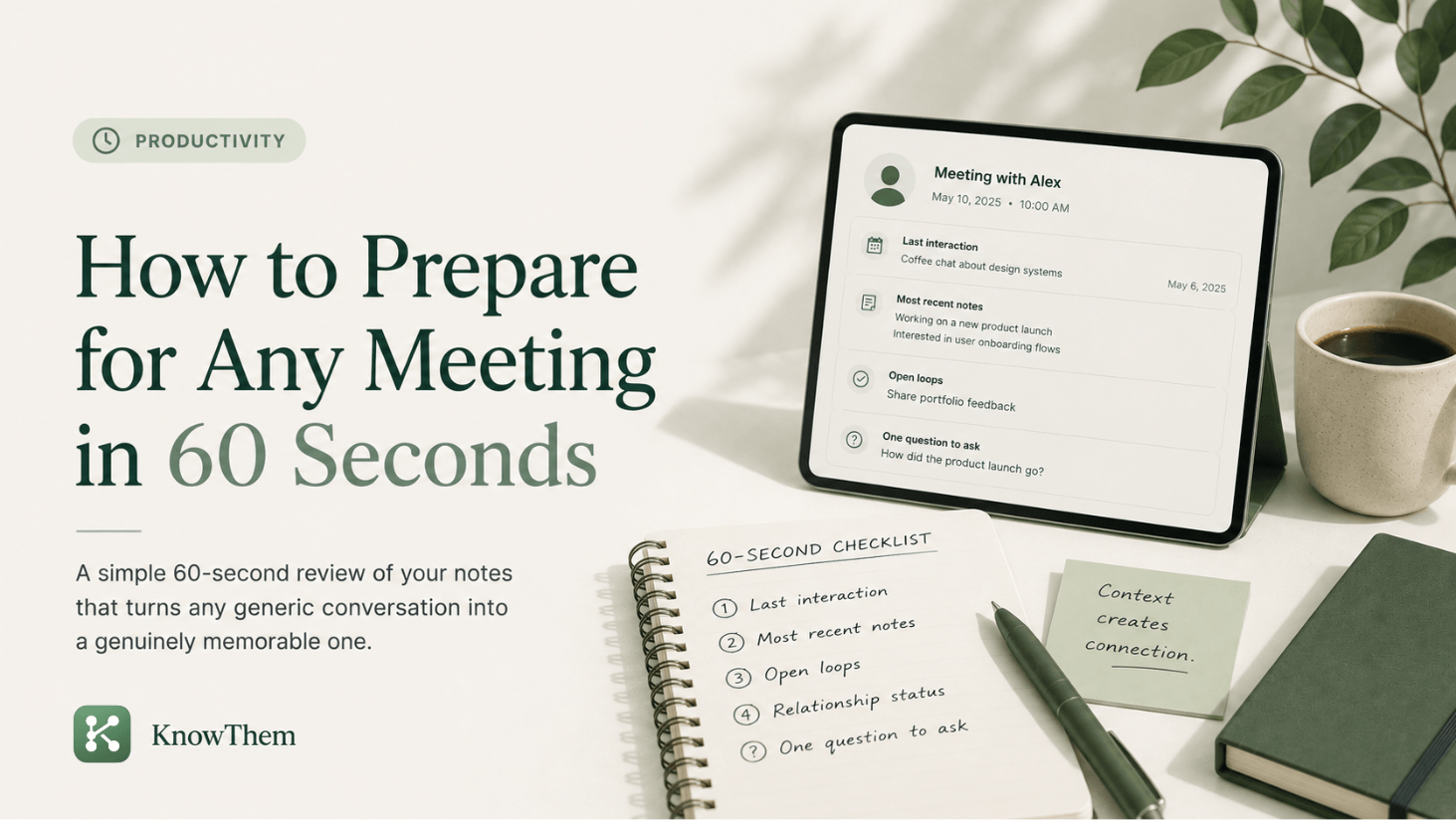
There's a version of yourself that walks into every meeting completely prepared. You know what you discussed last time. You remember what the other person mentioned they were working on. You have a sense of what they care about, what's changed in their life recently, and where you left things. You ask one question and their face lights up because you remembered.
And then there's the version most people actually experience: a calendar notification three minutes before the call, a frantic scroll through email threads, a best-guess reconstruction of the last conversation, and the faint awkwardness of asking something you were definitely already told.
The gap between these two experiences isn't intelligence or memory. It's preparation. Specifically: a 60-second review of your notes before the meeting starts.
Why 60 Seconds Is Enough
Meeting preparation doesn't require deep research. You're not writing a thesis; you're refreshing context that already exists. The information is there. The question is whether you've surfaced it before you need it, or left it buried.
Sixty seconds is enough to read the key details from your last interaction, scan your notes for anything relevant, and remind yourself what you agreed to follow up on. That's all. The goal is not to re-learn everything about this person; it's to activate the context that's already in your memory but temporarily dormant.
"You don't need to re-learn everything about a person before a meeting. You just need to activate the context that's already there, before the conversation, not during it."
The 60-Second Pre-Meeting Ritual
Open the person's profile, start a timer, and read through these five things in order:
1. Last interaction (15 sec): When did you last speak? What type? What was the outcome?
2. Most recent notes (20 sec): What did they mention? What were they working on? Any personal context?
3. Open loops (10 sec): Did you say you'd send something, make an intro, or follow up on anything?
4. Relationship status (5 sec): Is this relationship warm or has it been a while? Adjust your energy accordingly.
5. One question to ask (10 sec): Based on what you read, what's one specific thing worth bringing up?
That's the entire ritual. Most of it is reading, not thinking. The thinking happens automatically as you scan; your brain is very good at pattern-matching context when it's presented, even briefly.
What Makes This Work: The Quality of Your Notes
The 60-second ritual only works if the notes are actually there. This is where most people fail: they have great intentions about note-taking but don't have a consistent place to put them, so the information exists in scattered email threads, voice memos, and mental fragments rather than in one place you can review in a minute.
The notes worth capturing after any significant interaction are surprisingly minimal:
- What were they working on or worried about?
- What did you commit to doing?
- Any personal detail they mentioned (family, travel, a project, a challenge)?
- What's the right timing for the next touchpoint?
Four things. Three minutes. If you do this immediately after a meeting, while the conversation is still fresh, the effort is trivial. If you wait a week, you've already lost most of the useful detail.
"The notes you take two minutes after a meeting are worth ten times the notes you try to reconstruct a week later from memory."
The Loop: Before and After
The ritual has two parts, and most people only do the second one badly, which is why neither works:
Before the meeting: 60-second review of existing notes and interaction history. Surface context, identify open loops, pick one good question.
After the meeting: 2-minute note-taking window. What changed? What matters? What did you agree to? Log it as an interaction with a short note. Set a reminder if needed.
When you do this consistently, something interesting happens over time: each meeting becomes easier to prepare for, because you've been building a rich, searchable record of every interaction. After a year, you have a genuine relationship ledger, not a vague memory that degrades with each passing week.
Building the Habit
The most reliable way to make the 60-second review a consistent habit is to attach it to something you already do before every call: opening the calendar invite. Add a link to your relationship manager profile in the meeting notes or calendar description. One click, 60 seconds, done.
You don't need willpower to build this habit; you just need to remove the friction between the meeting notification and the relevant notes. If the review requires navigating to a different app, searching for the person, and loading their profile, it's too slow to do consistently. If it's one click from your calendar, it's almost free.
That's why people who use KnowThem often connect their reminders to Google Calendar, so the context lives right next to the event that needs it.
Build the habit with KnowThem.
Log interactions in seconds, review before meetings in 60, and let reminders sync directly to your Google Calendar.
Get Started Free