PRM vs CRM: The Difference That Actually Matters
CRMs and PRMs both claim to help you manage relationships. But the design philosophy behind each creates a completely different experience and a completely different kind of behavior.
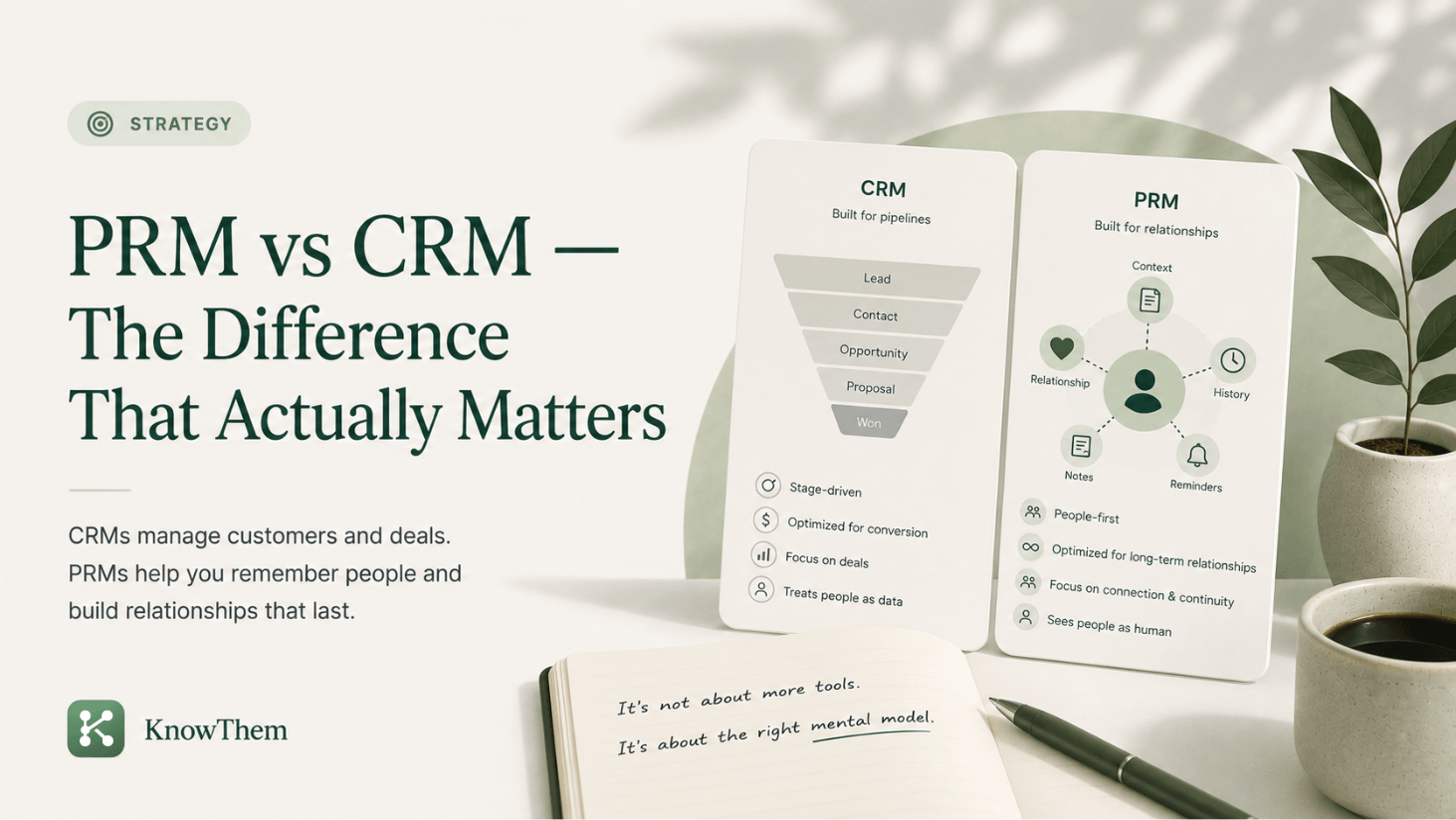
CRM stands for Customer Relationship Management. The word customer is doing a lot of work there, and it's a word that subtly shapes every decision that went into building those tools.
CRMs were designed in the 1990s for sales teams. Their job was to help organizations track interactions with potential buyers, manage deal stages, and forecast revenue. Every feature, including pipeline views, lead scoring, contact stages, and follow-up sequences, is optimized for a specific outcome: closing deals.
That's a completely legitimate use case. But it has nothing to do with the kind of relationship you have with a college friend, a mentor, a collaborator, or even a client you genuinely care about as a human being.
The Architecture of a CRM
To understand why CRMs feel wrong for personal relationships, you have to understand the mental model they're built on: the funnel.
In a CRM, every contact has a "stage." They're a lead, a prospect, an opportunity, a customer, or a churned account. They move through the funnel as you take actions. The software optimizes for moving them forward, not for genuinely knowing them.
CRM Mental Model
- Person = contact in a pipeline
- Success = deal closed or stage advanced
- Follow-up = sequence trigger
- Notes = deal context, not human context
- Inactivity = opportunity lost
- Metrics = conversion rate, win rate
PRM Mental Model
- Person = human being with a history
- Success = relationship maintained over time
- Follow-up = genuine check-in
- Notes = personal context and memory
- Inactivity = relationship drifting; surface it
- Metrics = interaction frequency, relationship health
The difference isn't just semantic. The mental model shapes behavior. When your tool presents someone as a "lead," you unconsciously relate to them as a lead, even when you consciously don't want to. The framing leaks into how you write notes, how you think about follow-ups, how you evaluate whether an interaction "worked."
"Your tools shape your behavior. When a CRM shows someone as a 'lead at stage 3,' it's impossible to engage with them as purely a human, even when that's all you want to do."
What a PRM Is Optimized For
A Personal Relationship Manager starts from a different premise: relationships are ends in themselves, not means to a commercial outcome. The tool's job isn't to move people through a funnel; it's to help you be a better, more attentive person over a long time horizon.
This changes the design priorities significantly:
- Memory over pipeline: The primary function is capturing and surfacing context, not tracking stages
- Health over conversion: The key metric is whether a relationship is Active, Warm, Inactive, or Cold, not whether a deal is won or lost
- Reminder over sequence: Follow-ups are personal prompts, not automated drip campaigns
- Context over scoring: What matters is what you know about this person, not a number that predicts their likelihood to buy
The Problem With "Personal CRM" as a Category Name
The phrase "Personal CRM" is widely used, including by KnowThem in some contexts, because it's recognizable. People who hear "personal CRM" immediately understand the general category of tool being described.
But the name brings the baggage of the CRM mental model. When someone searches for a "personal CRM," they often end up trying Notion templates that replicate the pipeline view, or lightweight sales tools that have been superficially rebranded for personal use.
None of these are actually designed around how personal relationships work. They're designed around how sales funnels work, dressed up in warmer language.
"A 'personal CRM' built on a sales template is like using a spreadsheet designed for inventory to track your reading list. It sort of works, but the structure fights you at every step."
When CRM Is Right and When PRM Is Right
This isn't an argument that CRMs are bad. They're excellent at what they were designed for. The question is what you're trying to accomplish.
- Use a CRM if you're managing a sales pipeline, tracking deal stages, or coordinating outreach across a team
- Use a PRM if you want to remember the people in your life more intentionally, as humans and not as opportunities
- Use both if you have professional relationships that require pipeline tracking and personal relationships you want to maintain beyond the deal
The most common mistake isn't choosing the wrong tool; it's trying to use one tool for both use cases and ending up with neither working well.
The Long Game
The real difference between CRM and PRM thinking shows up over years, not weeks. A CRM that tracks all your closed deals from five years ago is a record of business outcomes. A PRM that tracks your interactions with someone over five years is a record of a relationship, its shape, its evolution, the moments that mattered.
Only one of those feels human.
Related reading
A PRM built for people, not pipelines.
KnowThem is designed from the ground up to remember humans, not manage leads. Free to start, no sales CRM baggage.
Get Started Free