5 Signs Your Relationship Management System Is Broken
Most people's relationship "system" is a combination of memory, a phone contacts app, and good intentions. That sounds fine, until it isn't. Here's how to tell if yours is working.
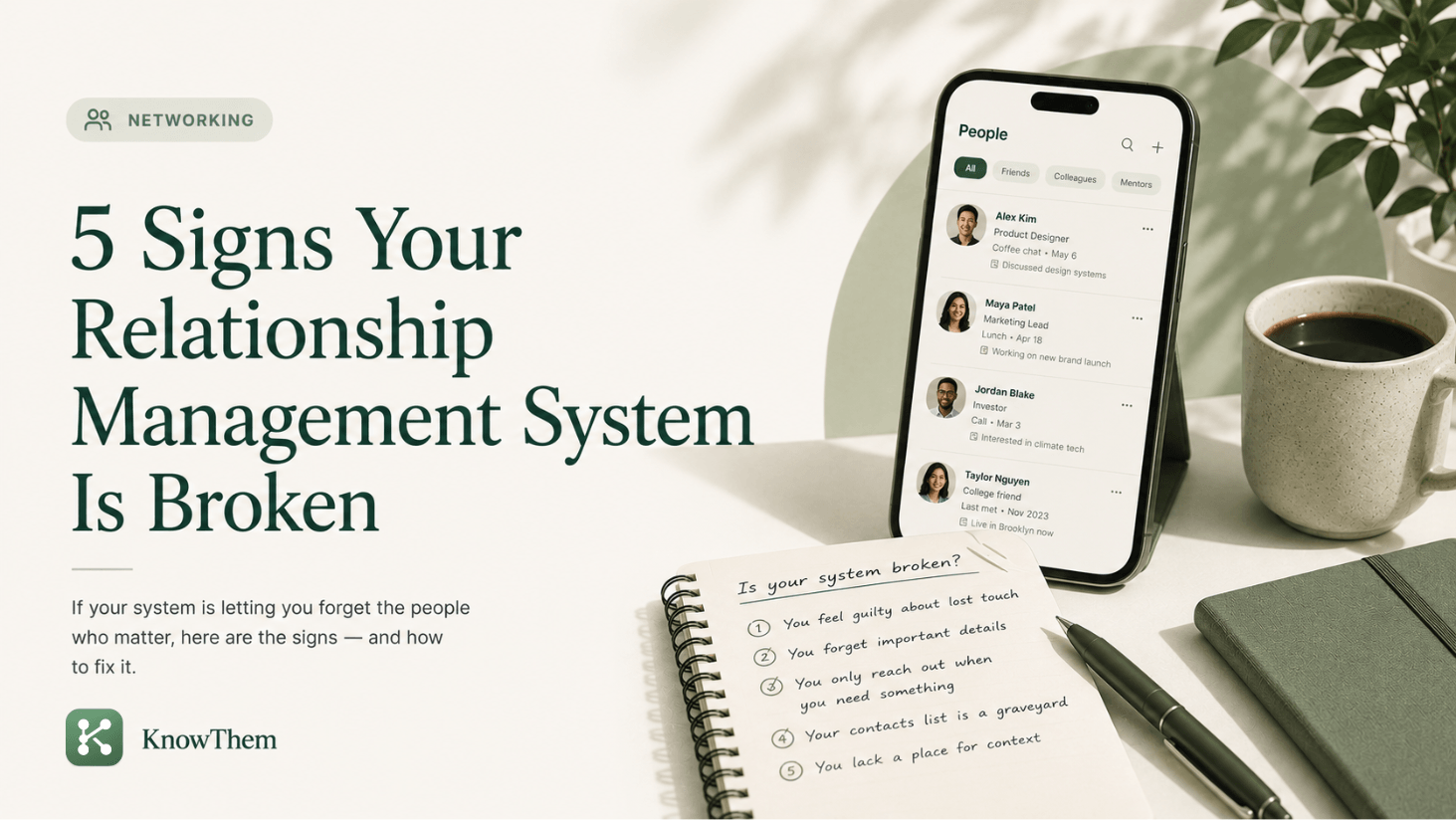
Most people don't think of themselves as having a relationship management "system" at all. They just... know people. They stay in touch when they remember to. They reach out when there's a reason. That's how human relationships work, right?
In some ways, yes. But as your network grows, as college leads to work, which leads to new cities and new communities, and the number of people you actually care about crosses into the hundreds, relying entirely on memory and spontaneous impulse starts producing visible failures.
Here are five of the most common symptoms. If you recognize more than two, your system is telling you something.
There's a specific kind of social guilt that accumulates quietly. You think of someone, an old colleague, a mentor, a friend from a previous chapter of your life, and immediately feel the weight of too much time having passed. You mean to reach out. You don't. The guilt compounds.
This isn't a character problem. It's a visibility problem. The relationships that matter most to you are the ones not currently in front of you, and without a system to surface them, they drift indefinitely. A broken system lets the people you value most become the ones you think of most guiltily.
Someone told you they were in the middle of a career transition three months ago. You run into them again. They ask what you thought of the decision they made. You have no idea what decision they're referring to.
Or worse: you ask a question you were definitely already told the answer to. The person notices, you can see it on their face, and the connection loses a little warmth in that moment. Details are the currency of genuine relationships. Forgetting them signals that the person didn't matter enough to remember. Even if that's completely untrue.
This one is uncomfortable to acknowledge. If you review your outreach history, is there a pattern? Do you tend to contact people when you have a favor to ask, a job lead to chase, or a collaboration you're hoping to initiate?
This isn't purely selfishness; it's how human attention works when relationships aren't actively managed. The moment of need is the only predictable trigger that overcomes the inertia of not reaching out. But relationships built entirely on transactional contact feel hollow to both parties, and they won't survive as genuine connections over time.
Open your phone contacts. Scroll through it. How many of those people are still active relationships, people you could message today without it being strange? For most people, the honest answer is: fewer than they'd like.
The contacts app is a flat list with no memory, no health status, and no mechanism for surfacing which relationships are drifting. It stores names. It doesn't help you maintain connections. The result is a database of people you used to know rather than a network of people you actively know.
After an important conversation, where does the context go? If the answer is "into my head," "maybe a note on my phone," or "I just remember it," your system is too fragmented to be reliable.
Context scattered across phone notes, email threads, calendar descriptions, and memory isn't a system; it's chaos with better intentions. When you need to find information before a meeting, you're reconstructing it from fragments instead of reading a clean record. That reconstruction takes time and usually produces an incomplete picture.
"Recognizing that your system is broken is the beginning of fixing it. Most people never even name the problem; they just carry the guilt indefinitely."
You Don't Need a Perfect System. You Need a Consistent One.
The solution to a broken system isn't a more elaborate system. It's a simpler one that you'll actually use. The goal is to go from "no consistent practice" to "a lightweight habit that compounds over time," not to build a comprehensive database before you see any value.
Start with five people. Log one interaction a day for a week. Set one reminder for someone you've been meaning to follow up with. The compounding starts immediately. After a month, you'll notice the guilt fading, because you'll have replaced it with a practice.
Related reading
Start with 5 people. Build from there.
KnowThem tracks relationship health automatically, surfaces who's drifting, and gives you one place for all your relationship context. Free to start.
Get Started Free