Why You Need a Personal Relationship Manager
You have systems for your tasks, your calendar, your notes, and your files. But do you have a system for the people in your life? Here's what a PRM actually is, and why it changes everything.
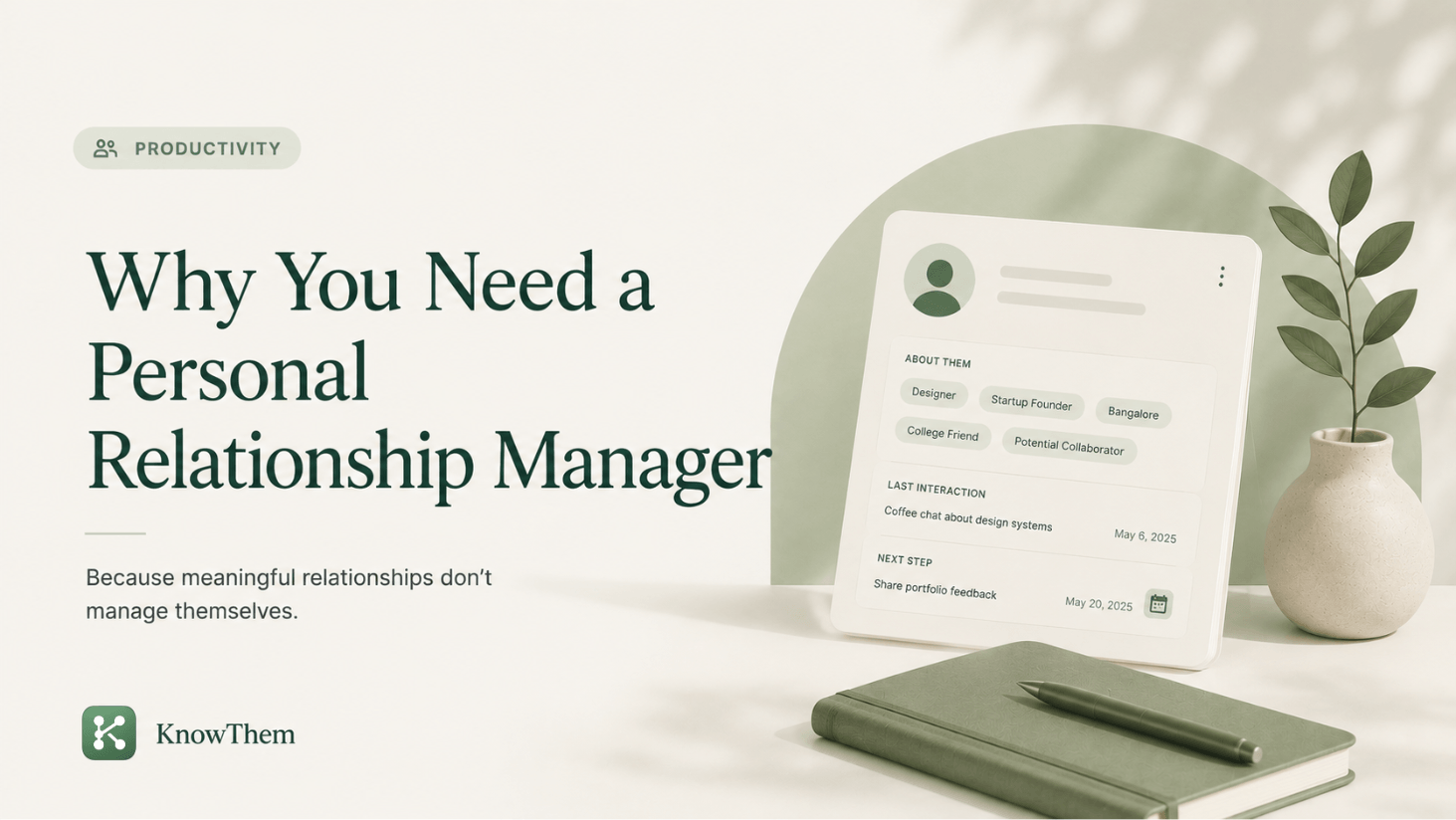
There's a particular kind of embarrassment that's hard to describe but instantly recognizable. You run into someone you've met before, maybe multiple times, and the details just aren't there. You remember the face. Maybe the context. But the name, the specifics of your last conversation, the thing they mentioned they were working on, all gone.
Or you meet someone new, have a genuinely interesting conversation, exchange details with the intent of following up, and then never do, because two weeks later they've slipped completely from your mental workload. Not because you didn't care. But because you have no system for carrying people forward in time.
This is the problem a Personal Relationship Manager solves. Not the embarrassment itself, but the underlying cause: the absence of any system for relationship continuity.
What a PRM Is (And What It Isn't)
The acronym trips people up, because it sounds too close to CRM (Customer Relationship Manager). The name similarity is unfortunate, because the two tools serve fundamentally different purposes and create completely different emotional experiences.
CRM (Sales Tool)
- Contact → Lead → Prospect → Deal → Revenue
- Optimized for conversion, follow-up sequences
- Designed for teams managing pipelines
- People are measured by deal stage and value
- Cold and transactional by design
PRM (Relationship Tool)
- Contact → Person → Context → Ongoing relationship
- Optimized for continuity, memory, and care
- Designed for individuals managing their network
- People are remembered as humans, not metrics
- Calm, intentional, personal
Using a CRM for personal relationships is the wrong tool for the job, not because CRMs are bad, but because the pipeline metaphor maps incorrectly onto human connection. Your grandmother isn't a lead. Your college friend isn't a prospect. Treating them like one, even subconsciously, changes how you relate to them.
The Cognitive Load of Relationships
Cognitive load is the mental effort required to hold, process, and act on information. When you're trying to remember a friend's recent job change, your colleague's kid's name, the follow-up you promised someone three weeks ago, and the birthday coming up next week, all simultaneously across dozens or hundreds of relationships, the cognitive load becomes significant.
This isn't a personality problem. It's a capacity problem. Humans can easily recognize and remember thousands of people, but holding the contextual details of hundreds of relationships simultaneously is another matter entirely. What someone mentioned they were working on, what you promised to follow up on, who you haven't spoken to in months: that kind of active relationship context degrades quickly without reinforcement.
"Humans are good at recognizing faces and names. They're not good at maintaining the active context of hundreds of relationships at once: who needs a check-in, what was promised, what has changed."
The result is a diffuse, low-grade guilt that most people carry without naming: the sense that you're not keeping up with people the way you should, that relationships are drifting, that you're perpetually behind on follow-ups you meant to make months ago.
A PRM doesn't make you a more organized person. It moves that cognitive load from your brain into a system that can hold it reliably, indefinitely, and without anxiety.
The Forgetting Problem, Specifically
Memory research consistently shows that without reinforcement, contextual details about people fade within days. Within a week of meeting someone, you'll typically retain their name and general impression, but lose most of the specific details that made the conversation valuable: what they were working on, what they said about their current challenge, what you talked about that made it worth following up.
This creates a compounding problem. If you don't log the context while it's fresh, you won't have it when you need it. And without that context, your follow-ups become generic instead of specific, which is precisely why they feel hollow, and why you procrastinate sending them.
Log the most important detail from any significant conversation within two minutes of it ending, before something else displaces it. A single sentence is enough: "Working on a new fintech product, frustrated with hiring. Follow up in 3 weeks." That sentence, captured now, is worth more than a detailed note written tomorrow from memory.
What a PRM Actually Does Day to Day
The practical function of a Personal Relationship Manager isn't complicated. It does a small set of things consistently, and those things compound over time.
- Stores rich profiles with notes, context, relationship history, and details you'd otherwise lose
- Logs interactions as they happen, so you have a timeline of your relationship with each person, not a vague sense of "we've talked before"
- Tracks relationship health automatically and surfaces who you haven't spoken to in a while, before the relationship drifts too far
- Sends reminders at the right moment, not a generic daily digest, but a specific prompt tied to a specific person at a relevant time
- Makes context instantly retrievable. Before a call or meeting, you can review exactly where things stand without relying on memory
Who Benefits Most
While almost anyone with meaningful relationships benefits from a PRM, a few groups find the value particularly immediate:
Founders who are simultaneously managing investor relationships, potential hires, early customers, and a dozen other constituencies, each requiring different context and different follow-up cadences.
Freelancers and consultants whose livelihood depends on maintaining warm relationships with past clients, even during gaps between projects.
Super-connectors, people who introduce others, facilitate opportunities, and serve as network hubs, who need to track not just their own relationships but the connections between people they know.
Anyone who has ever felt the specific embarrassment of running into someone they should know better than they do, and wanting a system that prevents it from happening again.
How to Start Without Overwhelm
The most common mistake when adopting any new system is trying to make it complete before using it. Don't attempt to import and tag five hundred contacts in week one. That's not how relationship managers become habitual tools; it's how they become abandoned projects.
- Start with 10–15 people you actually care about maintaining a relationship with right now
- Add one interaction log per day, as it happens. Don't try to reconstruct history retroactively
- Set reminders only for people you genuinely intend to follow up with, not as a blanket exercise
- Add contacts organically as you meet people, not in batches
- Let the habit form around real interactions, not data entry
"A PRM isn't about becoming more productive. It's about being more present, more intentional with the people who matter, more consistently, over a longer time horizon."
The goal is not an immaculate database. The goal is a system that reduces the cognitive overhead of relationships enough that you actually show up for them, reliably, specifically, and without the anxiety of feeling perpetually behind.
Start small. Stay consistent. The compounding happens over months and years, not weeks.
Build your relationship system.
KnowThem is a calm, intentional workspace built for people who want to remember the people who matter, without it feeling like work.
Get Started Free